3 ways to fight election disinformation and rumors
Disinformation and rumors are already in high gear, and it's only going to get worse. Here's how to fight back.

Last updated October 31. See the update log at the end for details.
- THINK before you engage or share
- SHARE accurate information about the election
- EDUCATE yourself — and people you know
Disinformation and rumors are already in high gear, with a goal of manipulating the 2026 midterms, laying the groundwork for challenging the results when they lose and potentially staging a coup. The UW Center for the Informed Public's excellent Election Rumor Research series has discussions of machines switching votes, 'ballot dumping', and fake polls; AI-driven disinformation is running rampant on social media; and Russian operatives are very likely spreading fake videos targeting the Texas Senate race. It's going to get steadily more intense between now and Election Day and in the post-Election Day stages of counting ballots, lawsuits, and certifying results.
UW Center for an Informed Public's 6 moves of ‘rigged election’ rumors and Themes to Expect and Common themes to expect on and before Election Day are good overviews of the disinformation situation; their excellent Election Rumor Research series has in-depth discussions of how the administration, DOJ, and DHS are strategically creating content to create an illusion of widespread non-citizen voter fraud 'ballot dumping', fake polls, and much much more. Freedom Trainers' Election Defense Scenarios and the "Antifa" at the polls section of Free Press' NSPM-7: Enemies of the State are good context of the broader threats to the election.
This post focuses on how you can fight back – and why it's so important:
Terminology note: Misinformation is information that's false or misleading, but not necessarily intentionally. Disinformation, on the other hand, is information that's intentionally false or misleading. Rumors may or may not be true. Kate Starbird's What’s the difference between misinformation and disinformation? and Facts, frames, and (mis)interpretations: Understanding rumors as collective sensemaking have more
A couple of examples of how rumors could have a huge impact on the election.
- Potential rumors of ICE agents at polling places on Election Day. If true, it's important to get the word out as quickly as possible, both to protect people and to moblize a rapid response. But maybe they're not true, or being exaggerated as an attempt at digital voter suppression and a distraction for organizers, in which case it's important not to give the disinformation any more oxygen. Kate Starbird's suggestion on Bluesky
"Consider: Instead of posting rumors from other locations about ICE at the polls, post your or other's stories from your local community about successful voting & polling locations that are clear, b/c it will be just as important to know where it IS safe to vote."
- Potential claims by election observers of evidence of voting machine or tabulation errors. If true, rapid legal response and perhaps mobilization is critical. If false or its effect is being exaggerated, it's laying the groundwork for challenging certification so needs to be countered – and not amplified.
This article discusses three easy and important ways we can all help fight disinformation over the next few weeks. These are approaches that will work any social network – or in chat rooms, Signal threads, email exchanges, or real life.
- THINK before you engage or share
- SHARE accurate information about the election
- EDUCATE yourself — and people you know
Public service announcement: fighting disinfo is only one front in this battle, so please get involved more widely! Groundwork's Ground Control: Volunteer where it counts is a curated list of dozens of ways you can make a difference in person, on the phone, and online.
Note: Much of this information was originally based on work I did in 2020 with Shireen Mitchell, Stop Online Violence Against Women, Indivisible Plus Washington, Indivisible Whidbey, Washington Indivisible Network, and Indivisible's Truth Brigade. How To Respond to Disinformation and Digital Voter Suppression and Deep Dive goes into more detail (although hasn't been updated since 2020, so some of it's out of date). Thanks to all involved!
1. THINK before you engage or share
Shireen Mitchell’s All of us have been targeted by disinformation
As Shireen says, if you have an immediate reaction to share a link without verifying or fact-checking, you need to pause and look at things differently. One of the goals of disinformation is to get you to react emotionally. Even if it’s something you agree with, it’s important to think before you engage.
- Is the information you’re about to share accurate and from a reliable source? If not, be very careful not to give it more visibility when you’re trying to debunk it.
- Even if the information you’re about to share is accurate, look at the headline and any images that you’re sharing to make sure they’ve got the right framing.
- Avoid headlines, images, and videos that include disinfo. Instead, look for headlines and articles that focus on the accurate information, or report that there’s disinfo but don’t repeat it.
- If you can’t find a headline and article that work well, consider just quoting a few lines from an article (or taking a screenshot) rather than linking.
- Only share screenshots of disinfo if you are clearly visually labeling them as disinfo.
That last bullet is something I really wish more people understood. Back in 2020, when I was working with progressives on Twitter and Facebook, I was constantly exasperated with how often people would amplify disinfo to dunk on it. Now, it's happening on Threads, Bluesky, and Instagram too. Please don't help white supremacists and fascists by amplifying their propaganda!!!!
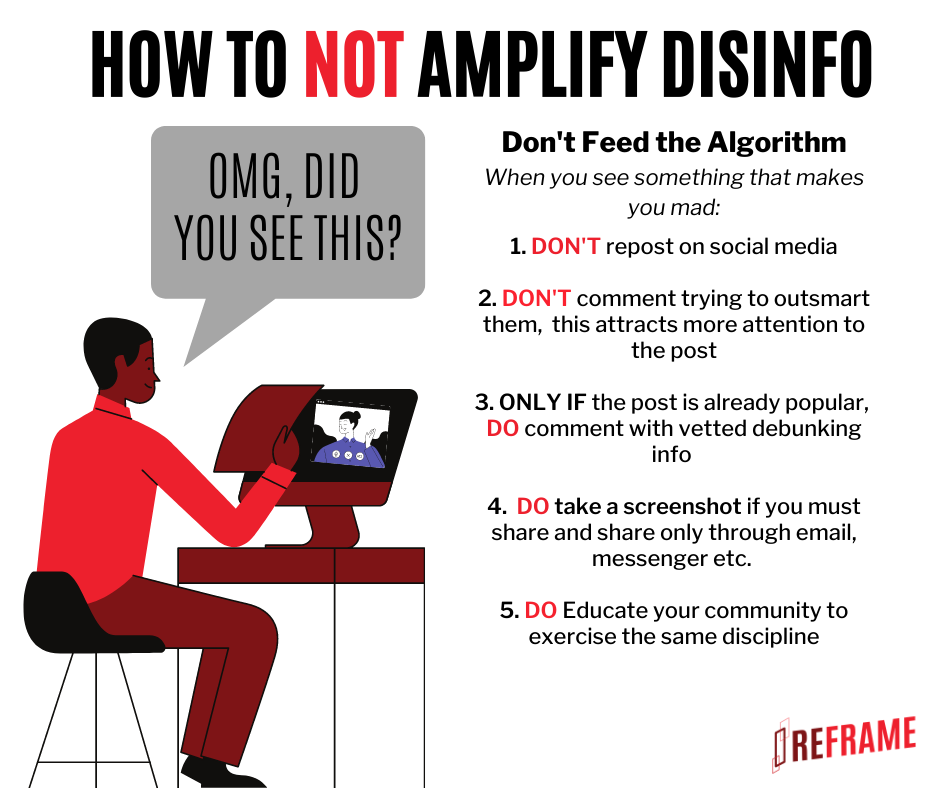
Shireen’s Deep Dive on Fighting Back Against Disinfo goes into a lot more detail on this. ReFrame also has some great infographics on how to not amplify disinfo, and Union of Concerned Scientists covers this and a lot of other valuable topics in Countering Disinformation in Your Community.

If you (or people you know) use chatbots like ChatGPT, Claude, Gemini, or Muse to get information about the election ... be very very careful! The recent Chatbots and the Ballot Box report from Institute for Strategic Dialogue found that 29% of responses to English-language election-related prompts were incomplete, incorrect, or outdated (including Muse Spark incorrectly reporting that Election Day is on a Wednesday this year) – and the numbers are even worse for Spanish-language queries. Similarly, Newsguard reports that leading AI chatbots cite partisan websites masquerading as independent local news outlets nearly half of the time when people ask about candidates and issues.
And don't even think about trusting Grok! Grok's election disinformation was so bad in 2024 that Secretaries of State got involved, and this year its owner is spending hundreds of millions of dollars to support Republicans while spewing disinfo and anti-trans bigotry on Xitter.
Speaking of "AI", keep in mind that these systems are getting steadily better at generating fake video and audio recordings. LLMs Are Still Making Election Deepfakes Just Days Before the US Midterms on Tech Policy Press covers recent research by the Brennan Center, and the news is not good; it's easy to get around the "safeguards" that are supposed to keep them from generating election misinformation (and Grok doesn't.even try to prevent abuse). By last month there were well over 100 examples of "AI-generated" attack ads this election, many of which are misleading. "AI-generated" fake videos and news stories are even more dangerous.
How to tell if information is accurate?

How to tell whether or not information is accurate? Mike Caulfield’s SIFT (The Four Moves) is a good short introduction to the SIFT method: stop; investigate the source; find better coverage; and trace claims, quotes, and media to the original context. The five-part Check Please! Starter Course goes into much more detail. IFTAS Library’s Misinformation page has links to additional resources for investigating potential disinformation.
And even credible sources sometimes get it wrong – especially when there's fast-breaking news and rumors are flying. WNYC On The Media’s Breaking News Consumer's Handbook has some good recommendations for these fast-moving situations. Here's their infographic summary – if you want to print it out, they've got a handy PDF file.

When you do decide to engage with disinformation, here’s the approach that ReFrame and other disinfo experts suggest:
- Lead with shared values to connect with your audience.
- Discredit the falsehood by naming the motivations driving the
disinformation. - State the falsehood you intend to inoculate against.
- Deliver factual information to combat the falsehood.
2. SHARE accurate information about the election
What is your plan to promote accurate, aspirational and actionable information about the solutions needed to protect your/our freedoms regarding the 2022 midterm election?
– – Shireen Mitchell in Disinformation: A Racist Tactic, from Slave Revolts to Elections, November 2022
Shireen's question is just as relevant in 2026.
The last few days of voting are always somewhat chaotic: with ballot box and polling place closures, long lines and broken machines, and reports of voter intimidation. In 2024, there were at least four reports of arson affecting ballots – three true, one was fake. One common (and illegal) digital voter suppression tactic is to share wrong addresses or inaccurate hours for polling places via texts and social media. Last minute announcements of poll closures add to the confusion ... sometimes they're real, sometimes they're not. It always takes time to count the ballots, and election denialists use that to reply that there are shenanigans happening so they can cast doubt on the final results.
One good way to counter disinformation about the election process is to share accurate information about the election. Take the time to verify that the information you’re sharing is accurate before you share updates!
Voting rights organizations, official state and county election sites, and reputable local media (including online-only sources) are usually the most reliable sources. Here in Washington state, for example, the statewide VoteWA.gov portal is a one-stop shop including a link to a of ballot boxes and voting centers, and sites like Thurston County Elections and King County Elections are also thorough and reliable. In the ramp-up to the election, I Will Vote, vote.org, and Common Cause all have easy-to-use links to makes it easy to find your voting or drop-off information no matter what state you live in. Share these links widely!
Voting rights organizations, official election sites, and reputable local and national media (including bloggers and newsletter writers) are also good sources to cut through the disinfo fog during the ballot counting. A few suggestions here:
- UW Center for the Informed Public publishes regular updates on election rumors and research (also available on their Election Rumor Rundown Substack).
- My voting-rights.news project provides Curated Election Defense feeds (available on Blacksky, mu.social, and Bluesky), with election-related sources from credible sources, including voting rights organizations and experts, secretaries of state, county election officials.
- The non-partisan Election Law Blog, run by Professor Richard L. Hasen, and Democracy Docket are great sources of information about the lawfare related to elections. We've already seen dozens of lawsuits, and we're likely to see hundreds more.
- Many city and county agencies and officials post information on Facebook or Instagram, and you can check their pages without having an account. If you use their apps, keep in mind that their algorithms might not show you these posts; check the pages directly.
What about partisan sources? Well, let's be honest: Republicans in general are doing their best to suppress votes and subvert the election (although there are certainly exceptions). In 2020 and 2024, by contrast, the Democratic party and Democratic politicians and elected officials generally provided accurate information about the elections, and the trend is continuing this year ... again though there certainly are exceptions.
Historically, mainstream media sources like the major news networks and national newspapers like the New York Times and the Washington Post have also provided credible information. This year, though, many of them are owned by people who are siding with the fascists, so it's hard to know how reliable they'll be if and when things get ugly. So it's very hard to know how reliable they'll be.
Well-reported local independent and non-profit media is typically a much better source than mainstream media. By contrast stay away from "pink slime" sites, which pretend to be local but aren't,and be very wary of any automated "AI aggregators" masquerading as media outlets.
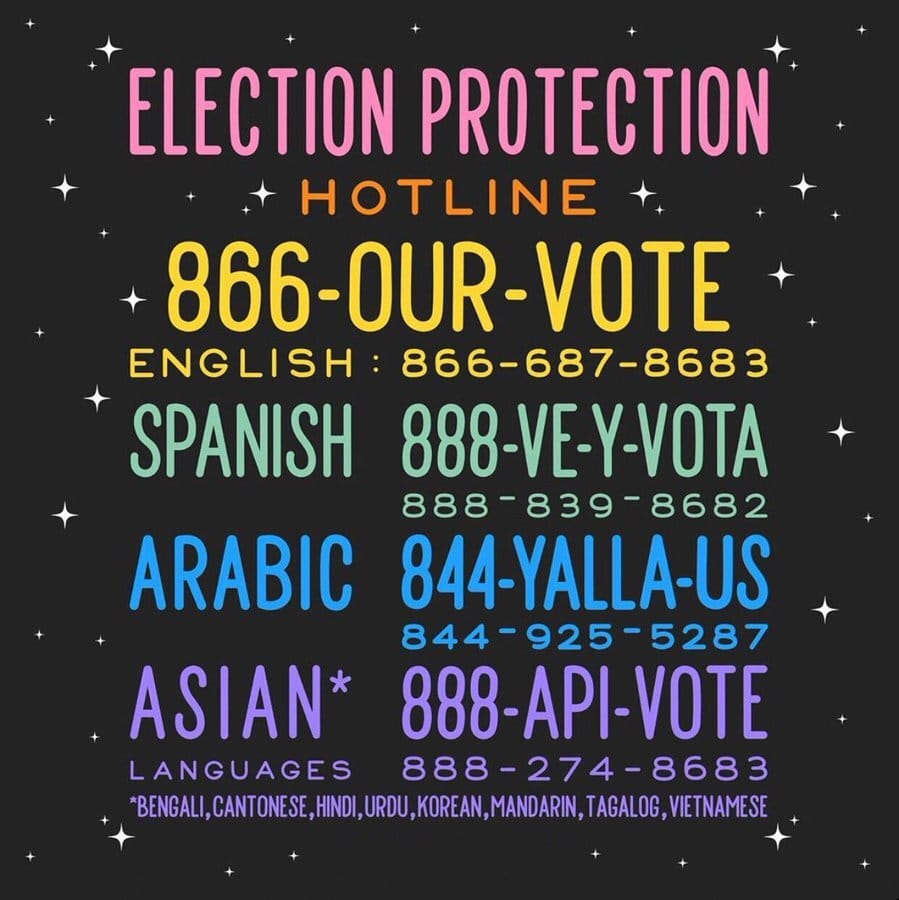
It’s also good to highlight the non-partisan Election Protection hotlines, useful for anybody experience voter intimidation or having other challenges voting. Trained volunteers are available in multiple languages:
English: 866-OUR-VOTE (866 687 8683)
Spanish/English: 888-VE-Y-VOTA (888 839 8682)
Arabic/English: 844-YALLA-US (844 925 5287)
English, Mandarin, Cantonese, Korean, Vietnamese, Tagalog, Urdu, Hindi, and Bengali: 888-API-VOTE (888 274 8683)
You can also contact Election Protection via WhatsApp, chat with them on their site 866ourvote.org or text MYVOTE to 866–687–8683.
3. EDUCATE yourselves — and people you know — about disinformation
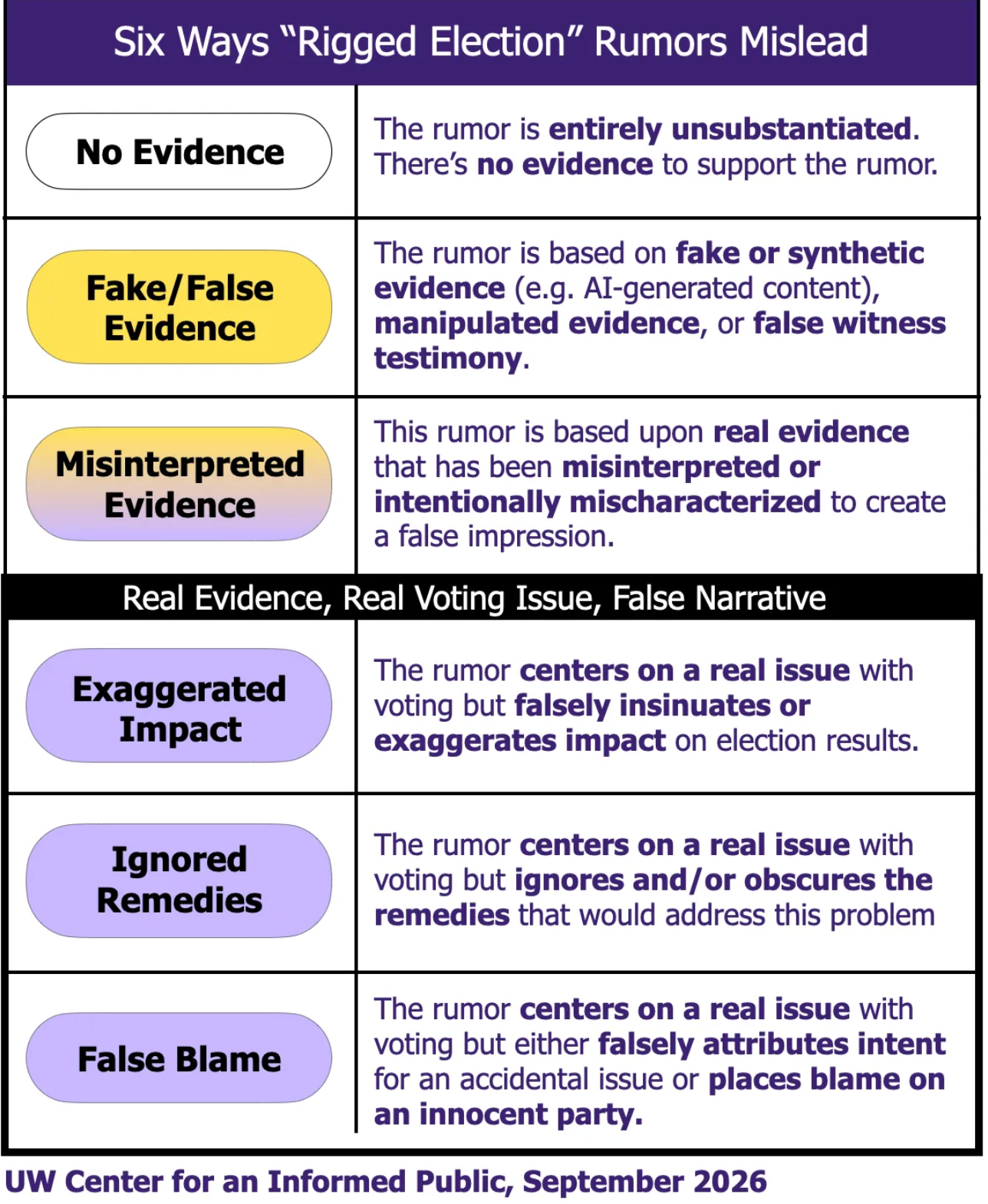
Election rumors and disinformation fall into some very predictable patterns. UW CIP's Common themes to expect on and before Election Day and 6 moves of ‘rigged election’ rumors (which expands on the excellent chat above) go into more detail. The Brennan Center's Anticipating Election Misinformation in the 2026 Midterms similarly covers several recurring election misinformation themes, all of which we're seeing this year: illegal registration and voting, foreign interference, voting machines, election worker malfeasance, and claims about results.
PEN America has a lot of great resources on disinformation, including the.How to Vote and Combat Political Disinformation: A Tip Sheet for Election 2024 (which lists many of the common disinformation narratives that are still relevant in 2026), a primer for news consumers on spotting and combating disinformation when news breaks, the two-minute video above (originally produced for the 2020 election, but still relevant), and the hour-long video below from 2024.
PEN America's Election Countdown: Combating the Most Dangerous Disinformation Trends (2024)
And you're not the only person who needs to recognize disinformation, avoid amplifying it, and respond. Your friends, family, and colleagues do as well. So as well as educating yourself, please share the knowledge. Union of Concerned Scientists' Countering Disinformation in Your Community and PEN America's How to Talk to Friends and Family Who Share Misinformation are also excellent resources; so is this video from Sabrina Joy Stevens.
Sabrina Joy Stevens, How to Counter Disinformation: Communication Strategies, Best Practices, and Pitfalls to Avoid (from Union of Concerned Scientists)
And I know I already mentioned it, but it's worth repeating ...
SIFT (The Four Moves) is a good short introduction to the SIFT method: stop; investigate the source; find better coverage; and trace claims, quotes, and media to the original context. The five-part Check Please! Starter Course goes into much more detail. IFTAS Library’s Misinformation page has links to additional resources for investigating potential disinformation.
And speaking of things I've mentioned before, even credible sources sometimes get it wrong – especially when there's fast-breaking news and rumors are flying. WNYC On The Media’s Breaking News Consumer's Handbook has some good recommendations for these fast-moving situations.
There's a lot of great information about disinformation out there ... here's one moer, a very detailed discussion from the University of Washington Center for the Informed Public's Mini Misinfo Day
Update log
Originally published October 15, based largely on 5 ways to fight election disinformation on Bluesky and the Fediverse (2024) (which in turn was based on a version from 2022 focuiong on Mastodon().
October 26-31: add some links, fix typos, replace graphics